Saturday, April 13, 2013

Stateside Global Health and Innovation

In keeping with my goal of posting blogs upon my return to the States, here is one on the 10th Annual Unite for Sight Conference from the eyes of a Batten public policy and public health student...


Seeing entrepreneurs, activists and enthusiasts descend upon Yale’s distinguished campus would seem like just another day on campus, but this is a bit different. The 10th Annual Unite for Site Global Health Innovations Conference ran from Saturday to Sunday of this past weekend and of course Batten could not be left out! This conference is entirely about policy from EVERYWHERE. Speakers from Ghana, India, Uganda, South Africa, Peru, Kosovo, Congo and more joined the over flowing auditoriums of do-gooders.

The conference kicked off with a speech by New York Times journalist, Tina Rosenberg, on harnessing the power of peer pressure: a topic that has been covered extensively by Batten psychology faculty. After beginning with references to alcoholism and drinking, Rosenberg asked the audience “which parents in the audience have told their children peer pressure is good. One could have heard a pin drop save a chuckle from the upper balcony, but it is what leaders want- to motivate people to action. Rosenberg advised the auditorium of global public health, medical professionals and students to “abandon their public health expertise,” but before the coup could ensue defending the professions of all in attendance she quickly began to clarify. Abandoning the expertise learned in school is not about forgetting the knowledge; it is striving to remember what motivates a non-expert in strategy development.

Peers are more credible. While experts are motivated by dire circumstances, enormous problems, and information, the average person blocks their discomfort out. To break through negative behaviors, research shows that marginalizing the bad behavior does more to incentivize good behavior that any public health message about a wide-spread problem. People want to fit in, so to change behavior is to credibly change perceptions of a norm.

The rest of the day was a fascinating version of just that. Any skeptic in the room would have been a minority among passionate optimist will logically framed arguments and innovators making pitches for the next big health advance.  In the end, the most important advice to policy makers and public health program coordinators boiled down to the following:
  •           Collaborate with stakeholders, don’t “help” them.
  •           Always ask why, not just for numbers.
  •           Understand history and context before implementation.
  •           Involve local peers in project design and marketing.
  •           Don’t claim causality lightly.
  •           Service should drive research. Ethical arguments exist for completing research and for not conducting it.
  •           Never promise the moon.
  •           Programs are always imperfect, but improvable (if evaluated).

Accidents Happen

In Uganda many people are religious. I am not generally one to claim massive amounts of religiosity, but yesterday was not my most shining moment in terms of luck, or maybe it was. My last morning in Kampala, my home-stay brother and I headed into town, but since taxi’s don’t come too close to his home, we boarded bodas. It was a hot day, a sunny day and like every day-one where I was not about to go off without my helmet. Regrettably, I left my jacket at home thinking it would be a hassle and make me more susceptible to pick-pockets in town if I was carrying too much or looking over heated. Bad move, even a cotton shirt won’t protect one in an accident.

Boda drivers are well known around Kampala for being crazy drivers- this was not the case yesterday. Driving slower than normal (probably from being a bit lost on where to go) the driver was being particularly careful, but in the cities- bodas are not the only ones on the road. Whether it was a taxi or just a regular car I will never know. White and too close for comfort were my only two thoughts as we fell. Then it was up and out of the road asap to check the damage.

This post is not to talk of battle scars or tell you to never ride a motorcycle.

It is to say there is a way to mitigate risk. A jacket would have saved my shoulder a lot of pain as would longer pants. The helmet saved my head from a lot of pain, and maybe my life. There is no back-tracking, no counter-factual and no photos to describe it, but today I’m not thanking God for saving my life. I am thanking my family for having prioritizing where to spend money- for buying what little insurance they could in the form of foam and hard plastic, and for my being wise enough to wear the thing without fail even when social pressures push for less being carried around. Helmets aren't an sign of being high maintenance. They are a sign of rationality. A 600$ full helmet (even if we did get it on sale) was worth every last penny and every pound of luggage when it broke my fall.

This post is to say accidents happen, you can never be too careful. Not everyone will understand why you lug the helmet around, but not everyone ends-up walking away.

So ride, as I surely will continue to need to do, but preparedness is more statistically significant that luck.

Saturday, April 6, 2013

The Risks of Movement: Pader (Pah Day)

A "better" Road
The drive to Pader district from Gulu takes hours on bumpy unpaved roads on a normal day, but that drive gets extended immensely as you find yourself having car trouble and saying good-bye as a downpour begins. The quantitative research team that I was paired with for travel had encountered two flat tires on their way to Gulu, and even after those repairs, the car was making strange noises. Rather than leave me to work at the hotel, I was picked up promptly to be deposited outside of the car in a “repair shop” or more honestly repair lot. There was not much one hitching a ride could do, but the other assistant and I sat near the front of the car patiently making chit-chat. There was a lot of work being done, and finally we thought things were just about done. The repair man hopped in the front seat to take it for a test. For most that would mean backing out of the lot and driving it, but apparently not for the repairman! Luckily for me, the assistant Ester grabbed me to the side (still seated in the little wooden chair) as the car rolled forward.

It really is one of those miscommunications that could come from anyone, anywhere, but it comes with the warning, don’t go on auto-pilot too often. With that near hit, I decided I was going to go get tea (especially since the noise was not gone yet after more than an hour’s work). Ester and I headed to a place “nearby” that was not so near, but we got seated and I was able to get to work. I have become so used to patience involving having a million things to do, and always having something to fill the time when it pops up. This has come with a persistent desire not to waste time and therefore a need to maintain my patience where work cannot be done.

newly paved road!
This trip was a reminder that travel time does not always equate to work time or productive time, sometimes it is just to be devoted to experience and silence. While the car work was being done I was able to do some work, but the drives were so bumpy enough that there was absolutely no way to do work or even have a conversation with someone in a different row of seats from you. It is ironic where opportunities come for self-reflection. The trips to and around Pader might be better seen as “hold on tight”-style meditations!
rocks being used to prevent people driving on the new road.
There is time to consider the prospects for education and how critical infrastructure is to the opportunities available to rural communities. The car we were in had been through a heck of a lot, and leaving the last school on Tuesday we drove through a rainstorm with leaking sun roofs (this car had 4 strangely placed ones) and almost spun off the road in the mud that was becoming soft and slippery. We needed to get to our hotel to keep things dry, and our bumper ended up in the very back seat after trying to pull off the road to a school the next morning. With infrastructure and repairs being needed so consistently, why would anyone want to invest in bringing big businesses to Uganda? When the accidents at the side of the road were 75% large (maybe overloaded) semi’s, would you want to invest in massive trade? Not until the roads were wide enough for two to pass without driving one another to crash along the canals at the side of the road trying to keep the road from washing away all together.
sign denoting the almost buried in dirt tracks

Additionally, there are train tracks and rail road crossings, but as you will be able to see from pictures hopefully, they clearly haven’t been used in quite some time and have grass and dirt built up high enough that you would derail anything that tried to run along the route. What if these routes worked? What if people actually could transport themselves and their goods by train to and from Kenya rather than by bus, car and truck? There would be a massive change. Fabrics in Uganda aren’t made there, but imagine the following supply chain: White fabric is made in Congo, sent across Uganda to Kenya to be tie-died via machines and then sent back to Uganda and Congo where it is sewn into clothing locally and sold in Kampala (and far less frequently in other towns’ markets). This is not only inefficient in terms of transportation costs, but it requires a risk to cargo on the roads in both the northeastern direction and the southwestern direction. Trains working on the railroads that pass through the Gulu and Pader districts wouldn’t solve their trade problems, but it would open up markets in a whole new light. Supply chain efficiencies are being considered for hospitals and medical supplies, but to increase the ability of small farmers to get goods to big markets and to facilitate large scale business to operate internationally in Africa there needs to be significant infrastructure progress made.

So let me describe the town of Pader for those who’ve never made it past Gulu or Lira. Pader is a sleepy town and only 2 streets wide and about 3 long. There are many small guest houses and tons of bars, but keep in mind that neither serve food regularly at night. When we arrived the first night we were directed to a specific restaurant by our hotel’s staff. On our second night Ester and I were feeling bold and wanted to try somewhere new for a change of scenery. After entering at least 7 places that clearly had TVs and alcohol, we gave up on finding food anywhere else and headed back to the one little eatery with its tables and chairs set up like a classroom facing the TV. Pader town didn’t seem to have any formal market just a few ‘general stores’ as you might imagine from the old mining towns of the American Southwest. A row of general house repairs, one of snacks and another of basic cooking supplies, period.
downtown pader

Staying in Pader we didn’t meet many locals outside of the schools. Our hotel staff members were luckily pretty good at English, so I spoke with the handyman/bar keeper in the evenings about living there. Steven hasn’t been there long yet clearly knows the place in an out. He’d lived all over Uganda and was seemingly well schooled, friendly and clearly hardworking. Seems like he won’t be staying indefinitely, but that for now it pays his way.

Innocent assisted us in conducting surveys in the Pader district and hearing her take on leaving for school only to return home had me impressed that she was able to readjust to village life. She hoped to go to the city again (Kampala) but would have to wait for work to take her there so that she could afford to live there- which after school fees was a non-option for her. Imagine trying to look for a job in a city a 4 hour bus ride away without constant internet access, job sites or even a newspaper (since most villages don’t even get that); it makes the village almost a trap when you get back there. You can’t afford to leave, and your lack of being able to just “tread the pavement and knock down doors” means that when people are hiring you may not hear about it.

Education is good. It gives a person hope, and if followed up with sound advice can prevent one from making poor decisions, but in some cases education also glamorizes opportunities out of the terms of reality.  Half the Sky is a book talking about women and starts out in discussions of trafficking and moves into maternal mortality (definitely recommend reading it if you haven’t). The point is that if you are educated you are less vulnerable to these schemes, if you are poor you still might chance it, but education helps to send up the red flags. Promises of work in the cities, Europe or even America are prevalent and very real for Ugandans. From posters in the city with “Want to work in America? PH:#######” are present and extremely tempting. In Uganda, being Caucasian comes with a sincere amount of clout, and so one offering work abroad is hard for one to imagine. One of the people I spoke with this trip asked my advice about taking up a man about this type of offer. So much risk for a group with so little to lose and seemingly everything to gain. Can you blame the chance they take?

Part of the challenge of development work is that its presence gives a false impression that things in the United States are all roses – for everyone. It is so far from the truth. One of my grandmothers used to ask, “why do you have to travel half way around the world to help people? People need you right here.” It’s true- very true, and trying to express that to the people abroad who are considering the risky choice of chancing a move to the US need to understand that as a piece of their education. Urban poverty shows the stark contrasts of the rich and the poor, but rural poverty creates a bubble that makes disparity look like the difference between having 2 cows and none rather than living in a slum vs having a flushing toilette.

urban prices in nowhere?! no way...
passing up chickens sold on the roadside
Misunderstandings about America are rampant, but when traveling humility and being willing to discuss issues of American poverty are important. Knowing your own country must happen before you can truly talk of poverty and opportunity. One of the most important things about driving across the USA as a learning experience is seeing the LA, Amarillo, Little Rock and Billstown differences and trailer parks along the way. In the US we see a broken down looking house an assume it is abandoned at first thought, but often that is not the case in places like Appalachia- urban migration has not dragged everyone out of them quite yet!


Tuesday, April 2, 2013

Regularity


While I would love for these posts to have come in a more regular manner, this is after all Africa. There is internet, there are cell phones all over, but not all of it can manage the uses most Americans would consider normal. Smart phones are almost always refurbished, copiers only work when power is on, and even the snazzier hotels are subject to slower connections for wi-fi. 

With that said, the technology accessible to African teachers and children in the norther Districts of Gulu and Pader were extremely meager. After visiting 15+ schools in the districts, there were a few with solar power, or close enough to town to make photocopies, and a majority with access to paper and chalk. Textbooks are more like the workbooks most kids in America are issued annually, but here in Uganda the most recent set was received in 2009 and doesn't necessarily match the curriculum in its most up-to-date form.

Education is valuable. It brings me to new places time and time again, but I believe in that value. The majority of rural Ugandans don't see it, and maybe that is because knowledge does not result in fruits for one's labors, only digging (gardening) does that. If you are a teacher in public Ugandan schools, you can have any level of certification and live in a hut without electricity or a private latrine and not get paid a dime more for your higher skill set or the quality of your teaching. So is there an incentive? 

Specialization. This is the answer many teachers resort to. They teach, continue their schooling and look to move into an industry where their skill sets will be rewarded. Problem is there aren't many. Government jobs are the most reliable (even if the pay checks don't come with sincere regularity). Parents chip in for additional teachers, accommodations, and feeding programs for their teachers, but in 3 years the teacher that was there is gone. Rarely do teachers stay at the same schools for long. Most stay less than 5 years before they are transferred (willingly or against their wishes) to new schools for their expertise or body count. 

Tragedy is common. Our first school visit took us to a relatively poor area that was not on a main taxi route (the ghetto super shuttle model mentioned in previous blogs), so to get to town you walk or hire a boda boda. since a private car is out of the question for most teachers.The school could not lock its classrooms, but was hopeful about the staff accommodations they were building for teachers nearby. 2 days later on a Saturday, we drove by the same school, roofless and barren after the latest storm's wind had taken off the roof and deposited it alongside the road in a mass of corrugated steel good for nothing but scrap. How does a school like this recover? In the US, FEMA would be dashing to the rescue. Here it will be up to parents whether kids take to sitting under a tree for awhile or have a repaired school building. If a storm like this had happened during the week, just imagine the consequences and casualties that would be found in 4 classes of 100 students as timber and bricks flew from the roof. 

This doesn't make the news, not even on the hotel TV in Gulu 25 minutes away. Had we not driven by, we would never have known the hardship this school would face in the coming months. Without a transfer of knowledge, what can government even be expected to do? There are distinctive needs for better monitoring of these types of events and better support from District Education Offices. Aid can't and shouldn't fix everything, Uganda needs its own regular methods to fix problems quickly as they arise. To show communities and individuals alike that what they do and who they are matters regularly, not just when some NGO shines a spotlight- more must be done locally.


Sunday, March 24, 2013

Diesel Station Karma Needed!

Gulu from a short-term expat perspective

A Gulu hotel's beautifully manicured perfection...
This is the first trip where I have been working alongside an internal organization and an international one. The partnership is good, the connections get us to a hotel, the driver knows his way around mostly, and we see much of Gulu passing by in a car. Not my usual.


A Gulu street- not bad, but not the smoothest ride!
Gulu is bustling and in many ways like Kampala in its friendliness and constant traffic, bodas (motorcycles) cutting people off, and NGO signs all over, but then it ends. Within 5 or so blocks, you are back facing "the villages." Unlike Rwanda, grass huts have not be wiped of the face of the country. Gulu has a Uchumi grocery store with everything a muzungu could want, but its size comes out with the fact that it only has one Forex Bureau.


Gulu's temporary marketplace
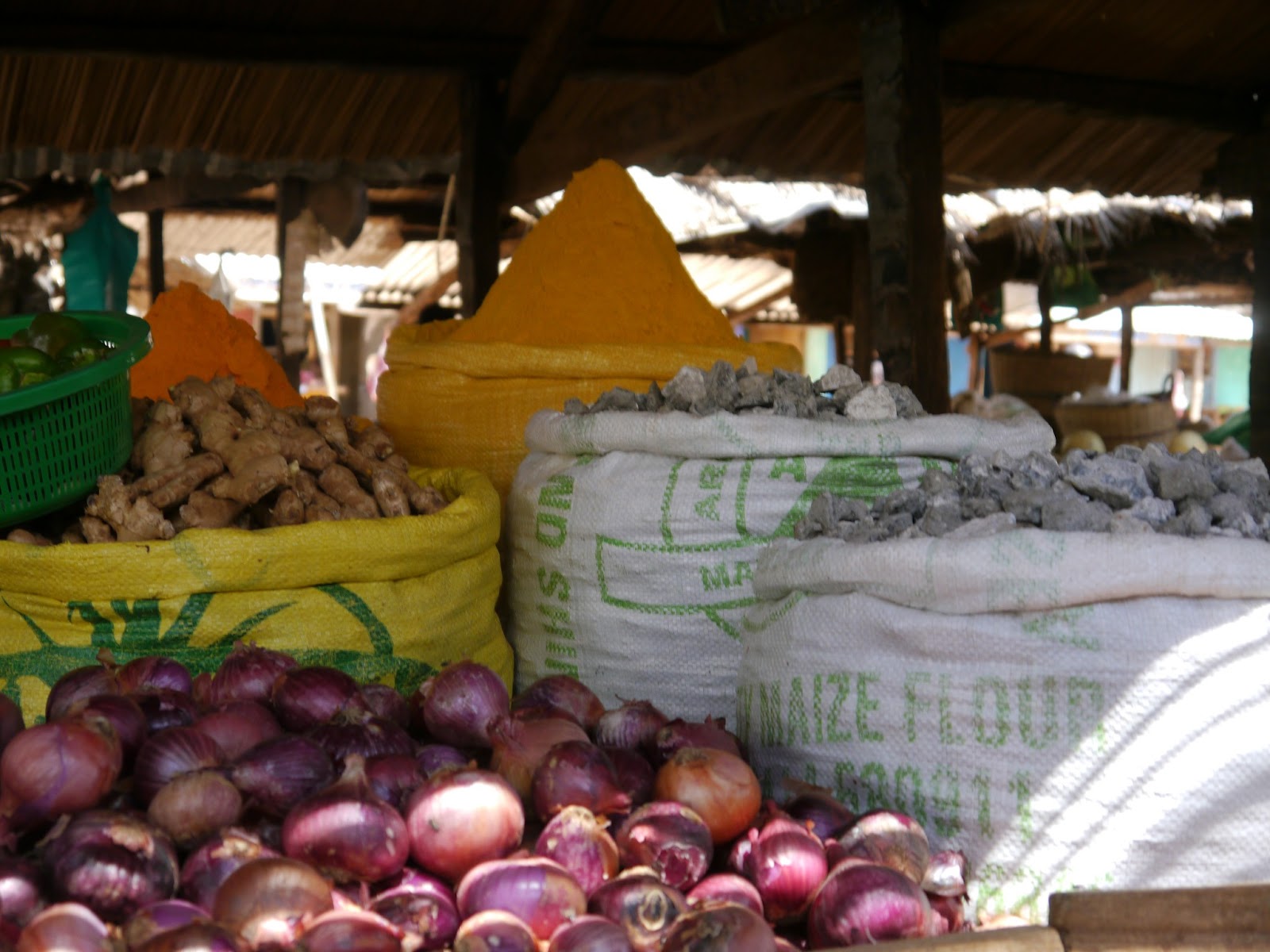
Gulu's new market place should be open 'soon', one that will ideally keep out the sun, the rain, and whatever other weather might be tossed Gulu's way. The building of the new market of course leads to a temporary market of haphazard yet orderly rows of structures that are full of the usual suspects from plastic bins, plates, and jerrycans to the most colorful of fruits and vegetables. Passion fruit, pineapple, papaya, water melons, tomatoes, pumpkins, potatoes, plantains, and onions- you name it, it is there! The colors are astounding and the smells distinctive. The chickens and fish can be smelled before they are seen, and driving up to the market it just took opening the car door to let the smells in. The ginger and spices and the sounds of people going about their business on the warm Sunday afternoon was refreshing from the clean white slippery tiles of our hotel.


Ceremonial bells were particularly prevalent at the market.
It was nice to be in Gulu- for real rather than for expats. The market sold Batwa pottery as well as knives and canes and ceremonial bells. I have get to see their usage, but my focus this trip has been on educational culture rather than that of tribes and ceremonies. The facets of culture that have come into this study of education indeed includes religion, tribes and gendered expectations, but it also speaks to a predominantly agrarian. As with most rural areas digging (or farming) is quite common and it is fare more rare to have any other type of profession- even with the massive influx of NGOs that the post-conflict peace has allowed to grow.


Cow salt rocks or onions?

Invisible Children made a name for Joseph Kony outside of Uganda by showing videos of abducted children, torturous enslavement and brutal murders. It is a quiet town now, where men play cards at the market and are back to worrying more about feeding themselves or which NGO can help them most than worried about gun shots down the road. It has quite a tragic past, and I definitely recommend reading up on it, but also stress the importance of not over victimizing those that have remained. They are survivors. In much the way that any other civilians feel during a time of war, these people lived wondering “will I be here tomorrow” and are now proud to have survived. 

The is so much talk of suffering here in Uganda, of poverty, of disease, of injustice, but there is so much laughter. Laughter at the market between ladies selling tomatoes, laughter of children, men laughing over a game of cards, and laughter as the lights go out yet again when the power goes out. This is not to say that life is not hard, that there isn't child labor or serious issues with domestic violence, but there is something else that brings out the laughter.

I believe that this is hope, and the belief that life goes on- if not for you, then for the next person. If for you, then it can get better. Hard work and taking risks works out for some people, and if you are well-educated, you will know the risks work taking and those to avoid. The schools we have seen aren't perfect. Most second graders probably still can't write their letters properly or copy them from another version on the board above them, but they are there and trying.

Valuing education is not automatic. It can be taught and has little to do with patience. The people of Uganda are patient. So much more patient than the average American. We have different standards of course, but subsistence farming demands patience, as does reconciliation, saving money you have in you possession rather than the bank and  not lashing out when what should happen doesn't. In some ways this allows for much of the corruption and transparency in the country, because people don't fight it, but also allows for growth and progress if the right people are in charge.

It is of course hard to know how or when that will be, but the teachers that are doing such good work give me hope for the next generation of Ugandans. I've heard a lot about social justice and giving women chances. It's been visible in some of the schools we've visited with their female head teachers (or principals), and will continue to blossom, but I will get to that in my next post!


Tuesday, March 19, 2013

On the road again!

 home away from home
With the travel bug you really can't help take an opportunity to travel when it is offered, so here comes a short adventure! Good karma comes around and this time it is taking me to Gulu, Uganda. As I hop on the plane, I am about to become Buganda again, Nakitende, as my second family named me. The family that gave me another sister and 4 fabulous brothers! Since home is where the heart is, I am always headed toward one and away from another. This time it involves leaving snow and fog and heading toward 80 degrees.

Gulu is a new town for me. I have been their only once, and sadly had Malaria the last time. This time will hopefully be a little less of a blow to my health. I am going to remember to steer clear of millet bread if possible and get my fill of matooke! Gulu is known for being a post-conflict region affected by the fighting of the Lord's Resistance Army and Joseph Kony, though things have been quiet there since my visit in 2009. The quiet allowed and in fact encouraged a booming expat social scene, but I hope to get more of a taste for local living that the expat circle. Expats for those of you unfamiliar with the term are internationals that have moved to another country for aid work, business, missionary work or as researchers. As such, the town has little hotels, a university and there is also a "bistro" with wi-fi mentioned that I will remain skeptical about until it allows me my next post!